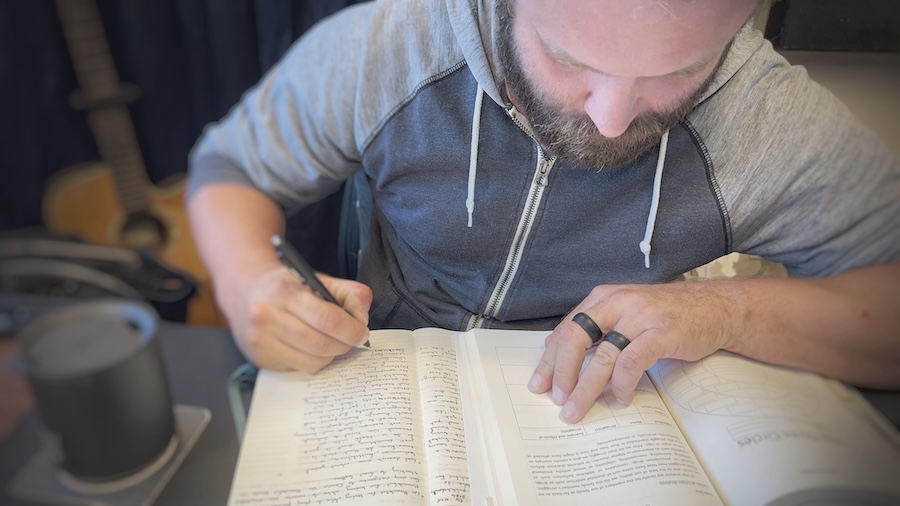
For a long time, I hated the idea of recovery programs. One of the reasons was the language. “Once an addict, always an addict” seemed to make something a person had done, or something that had once controlled them, an inherent part of their identity. But that subtly undermines what I believe about freedom.
If Jesus had set me free from something, then I was free. I might still struggle. I might even have momentary failures. But a failure didn’t suddenly redefine who I was or erase the freedom I had experienced.
Ironically, it was Galatians 5.1 that eventually helped me become more open to the idea of admitting addiction and pursuing recovery: “For freedom Christ has set us free. Stand firm, therefore, and do not submit again to a yoke of slavery.”
Paul could warn people who had genuinely been set free to not return to slavery.
Something clicked.
Being free didn’t mean I could never forfeit that freedom and return to bondage. But neither did one failure mean I had suddenly lost my freedom.
There was a difference between falling and submitting myself again to slavery. I’ll explore that distinction more in depth in a later blog post, because it has become an important part of how I understand the difference between sobriety and freedom.
But it also gave me the biblical framework for the version my recovery ministry uses (which I deeply appreciate): “Once an addict, always vulnerable.”
By “vulnerable”, I have taken this to mean having a particular susceptibility, pull, or desire toward an unhealthy coping behavior or mindset — something shaped through observed examples, lived experiences, and repeated choices, then reinforced through habit.
I’ve realized that I’ve been too quick to associate this kind of vulnerability only with the people I used to call “addicts” — something I’ll unpack more in a later post.
But Paul writes, “No temptation has overtaken you except what is common to mankind” (1 Corinthians 10.13). Temptation is part of our common human experience, but that doesn’t mean we’re all equally vulnerable to the same things. For example, I’ve never been tempted to use hard drugs. If meth happened to be left somewhere in the privacy of my home, I can’t imagine having any desire to use it. But put pornography in front of me at the most public place in a grocery store, I would be tempted to linger and side-eye the cover because I know that’s an area where I’m vulnerable.
Someone else may have no particular vulnerability to pornography or sexual addiction but struggle deeply with alcohol, control or micromanaging, food (whether through gluttony, bulimia, anorexia, or other unhealthy patterns), exercise, approval, anger or “being right”, social media, perfectionism, attention, or something entirely different. We’re all vulnerable to — tempted by — something. That’s humanity. However, our particular flavor of vulnerability is personal and unique to us.
While I still don’t particularly like “once an addict, always an addict”, I’ve come to understand the humility behind what people often mean when they identify themselves that way. They’re acknowledging ownership: “I did this. My choices were mine. The damage I caused was real. The consequences belong to me.”
But I’ve also learned to hear something else: “I know where I’m vulnerable. I know I need help. I know I can’t build my freedom on confidence in myself.”
For me, that last part has been especially important and a game-changer in my own recovery. Before, I never considered myself an addict. Or I would swing to the other extreme and sweepingly — and dismissively — accuse everyone of being an addict. Both allowed me to dismiss the seriousness of my own struggle and need.
I believed I was free, and I genuinely was — especially compared to my life before originally stepping into counseling and help back in 2008. But somewhere along the way, confidence in the freedom Jesus had given me subtly became confidence in myself and a dismissiveness toward my daily need for him.
I knew my history, but I underestimated my ongoing vulnerability.
Looking back, I can see how that gave me a sandy foundation. I believed I was strong enough to manage something I should have recognized I remained vulnerable to. And eventually, I fell.
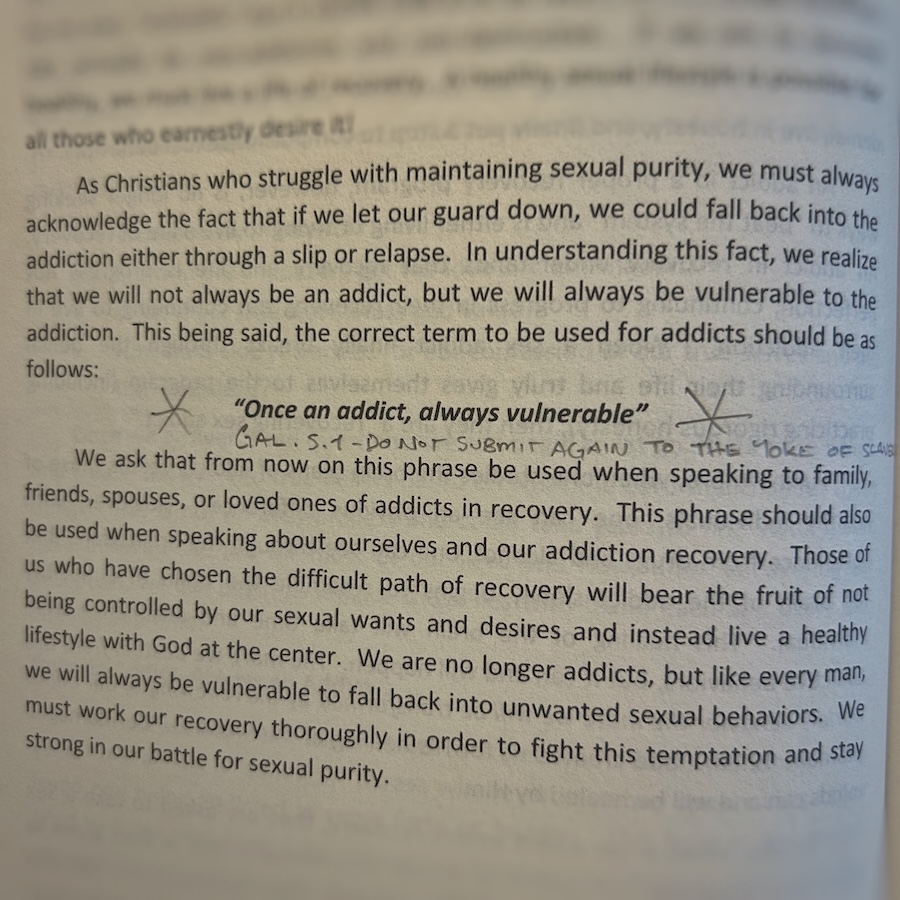
Castimonia © 2020, page 50
That’s helped me better understand the humility I now hear when someone in recovery says, “I’m an addict”. I still prefer the language my recovery ministry uses — “once an addict, always vulnerable” — however, I no longer hear the other phrase simply as someone making addiction their identity.
At its healthiest, I hear someone admitting their need.
For me, that means recognizing that my freedom isn’t sustained by pretending (or, at worst, lying to myself) that I’m no longer vulnerable. My foundation has to remain Jesus. I need him; I need to be honest and open with the people he’s placed around me; I need the humility to recognize where I’m weak; and I need to take daily inventory of my uncomfortable thoughts and emotions that lead to unnecessary vulnerability.
Moving forward, my hope in Jesus looks like recognizing I can be free while, at the same time, admitting I am still vulnerable.
This doesn’t diminish my freedom. Boundaries don’t diminish it. Asking for help doesn’t diminish it. Recognizing unhealthy patterns doesn’t diminish it. If anything, knowing AND admitting where I’m vulnerable actually helps me live out of the freedom Jesus has already given me.
Maybe part of God’s grace toward me is encouraging me to hold both truths together, in tension.
I don’t have to permanently identify people by what once held them captive (including myself). But I also don’t have to pretend that freedom makes them incapable of returning there.
I can own my failures without making them my identity.
I can acknowledge my vulnerabilities without denying my freedom.
And when I fall, I can get back up.
This grace isn’t just true for me. It is true for every person I work with who is willing to come face-to-face with where they’re addicted.
With hope,
Nathan
CLICK TO SUBSCRIBE